How to Keep Clear Meeting Minutes for Community Groups
Clear meeting minutes help community groups find past agreements, check current records and understand which version is approved or still a draft.
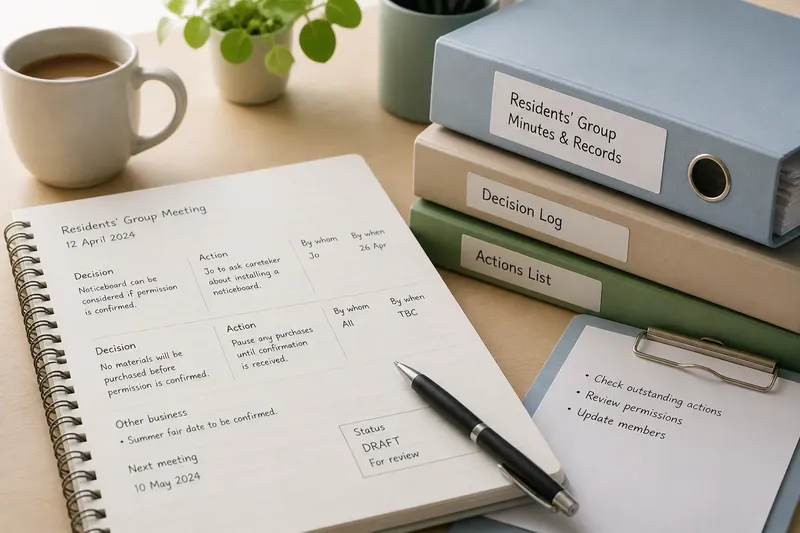
A volunteer opens a shared folder to check whether the hall booking was confirmed, but finds three files called “Meeting notes”. Clear meeting minutes give community groups a reliable record to return to, without turning every discussion into a transcript.
Minutes and records
Minutes are a concise account of a meeting. They usually record decisions, assigned actions and other business that members may need to revisit. A transcript tries to capture speech in sequence. For most community groups, minutes are easier to scan and more useful for following work over time.
A group may also keep records that are not minutes, such as a decision log, correspondence about a venue or a current list of assigned tasks. These documents have different jobs. Minutes preserve the meeting’s account; a decision log makes particular agreements easier to find across several meetings.
Choose a format the group can maintain. A shared document, paper notebook or simple spreadsheet can work. Use consistent names and a location members know how to access.
What to record
Agree a simple set of fields before the meeting. A useful entry can include the date, the agreed outcome, any condition attached to it, the next action, who is responsible and when the group will check progress. If the group’s rules call for formal motions or votes to be recorded, follow that format.
- Decision: Check whether the group actually settled the matter; if it did, record the agreed wording, and if not, mark it open.
- Condition: Check whether approval depends on something else; if it does, state the condition, and if not, do not imply one.
- Action: Check what needs to happen next; if there is a concrete task, write it down, and if there is none, leave the action field blank or state that no follow-up was agreed.
- Responsibility: Check whether a person or group accepted the task; if ownership is clear, name them, and if not, ask the meeting to assign it or record that ownership remains undecided.
- Timing: Check whether a due date or review point was agreed; if so, include it, and if not, avoid inventing one and leave timing open.
- Status: Check whether the record is a draft or approved; if approval is pending, label it as a draft, and if approval is complete, mark it approved under the group’s procedure.
- Access: Check whether the folder or notebook is available to the intended members; if it is, keep the record there, and if not, move it to an agreed accessible location or clarify permissions.
Do not treat a suggestion as an agreement simply because someone raised it. If the group has not decided, record that the issue remains open and note any next step it actually agreed. Keep context that changes how an outcome should be understood, but leave out conversational detail that does not help members interpret or carry out the decision.
Capture the wording
When the group settles an outcome, write a short draft in plain language. Include the action and any agreed responsibility, condition or timing. If the wording could be misunderstood, read it back before the meeting moves on. Members can correct an omitted condition or clarify who accepted a task.
Imagine a residents’ group agrees that Jo will ask the caretaker whether a noticeboard can be installed, and that nobody will buy materials before permission is confirmed. The minute should record both Jo’s enquiry and the pause on purchases. “Noticeboard discussed” records the subject but not what the group settled.
Keep the note neutral. “Members agreed to keep the current opening hours until the next review” describes an outcome without assigning motives. If a disagreement remains relevant, record the unresolved question rather than judging the people who raised it.
Draft and approval
After the meeting, turn rough notes into a readable draft. Check names, action owners, conditions and the difference between a decision and a proposal. Remove repetition, but do not change the meaning to make an uncomfortable outcome sound different.
Share the draft through the group’s agreed channel. Tell members how to report factual corrections, such as commenting on a shared document or contacting the note-taker. If formal approval happens at a later meeting, label the document as a draft until then.
Give each file a clear name that includes the group and meeting date. If an approved record is amended, make the change visible under the group’s procedure rather than silently replacing the file. Members should be able to distinguish the current version from an earlier one.
Storage and access
Keep minutes in a labelled folder, meeting binder or agreed records platform. Use a consistent filing order, and make sure the people responsible for maintaining records can retrieve them. A record is of little use if members cannot locate it.
Set access according to the group’s needs. Routine decisions may be available to all members, while personal or confidential details may need restricted handling. Record only information needed for the group’s work, and follow its access and retention rules. For legal, privacy or formal governance obligations, consult a qualified professional.
At later meetings, check the status of outstanding actions. If the group changes an earlier arrangement, record the new decision and make clear which earlier agreement it replaces. This preserves a usable record without suggesting that an old decision is still in force.
Questions about minutes?
Who can take the minutes?
A group can appoint a secretary, rotate the role or ask someone who is not leading the discussion. Follow the group’s rules, and choose a note-taker who can hear the decisions and responsibilities clearly.
Should minutes include every opinion?
No. Record the outcome and the context needed to understand it, not a running account of every contribution. Note a particular objection or view when the group’s rules or the decision’s meaning make it relevant.
What if members dispute the wording?
Check the draft against what the group actually decided, and correct factual errors or omissions. If the disagreement is about the decision itself, use the group’s decision process rather than altering the record to imply a different outcome.
How long should minutes be kept?
Follow the group’s retention policy and any applicable rules, which can vary by organisation and record type. If the group has no policy, agree one and seek qualified advice where legal or privacy responsibilities may apply.
Clear meeting minutes are most useful when someone returning to them can tell what is settled, what remains open and which record is current. A consistent file name and an honest status label can save members from acting on an old draft when the next task comes due.