A First-Time Participant’s Plan for Joining a Community Meeting
A first-time participant’s plan for a community meeting helps you find the agenda, choose one useful question and leave with a clear follow-up.

You find a community meeting notice on a library board, open the attached agenda on your phone, and realise you do not know anyone in the room. A first-time participant’s plan for a community meeting can make that first visit feel manageable: find out what is being discussed, choose one question, and keep a note of what you may need to follow up.
You do not need to understand every item or speak at length. The useful preparation depends on why you are going. You might be curious, affected by a proposal, carrying information for someone else, or simply deciding whether the group is one you want to know. Choose the approach that fits your situation rather than trying to prepare for every possibility.
Start with your reason
Before searching for documents, write one plain sentence about why you plan to attend. For instance: “I want to understand how the residents’ group is discussing the shared courtyard.” That sentence gives you a boundary. It helps you decide which agenda items matter and which can wait.
If you are attending out of curiosity, aim to learn how the group works. Notice who convenes the meeting, how people get a turn, and where decisions or actions are recorded. You can leave without speaking and still have learned something useful.
If an agenda item affects you directly, prepare around that item. If you are there on behalf of another person or group, check what you have permission to share and whether you are expected to report back. These are different purposes, so they call for different kinds of notes.
Choose your preparation
Use the situation below that most closely matches yours. Each calls for a small, practical plan, not a full study of the group’s history.
- You are curious but unsure: Find the agenda and meeting details. Pick one item you want to understand, and give yourself permission to listen. This suits a first visit because you can learn the group’s habits before deciding how much to contribute.
- A proposal may affect you: Read the relevant agenda item and any short paper linked to it. Note one concrete effect you want clarified, such as how a proposed change would affect access to a shared room. This keeps your contribution tied to the decision under discussion.
- You have information to share: Check whether the item is for discussion, a decision, or an update. Prepare a brief statement of what you know and where that information came from. If the detail is uncertain, say so rather than presenting it as settled.
- You are representing someone else: Agree beforehand what you can report, what you should ask, and what needs to remain private. If you cannot speak for the person on a particular point, make that limit clear. This helps the group understand the scope of your contribution.
- You are short on time: Identify the agenda item that matters most and check when it is likely to be discussed. If the order is unclear, ask the organiser whether you can join for that part. You can make a focused visit without treating the whole meeting as an obligation.
These plans do not require you to decide in advance whether you agree with a proposal. Your immediate task is to understand what is being asked and what information would help you respond.
Find the agenda
Look first at the meeting notice, the group’s website, an email invitation, or a noticeboard at a community centre or library. Search for the agenda, the time and place, any access details, and the name of an organiser. If the agenda is not attached, ask for it in a short message. You can also ask whether visitors may attend and whether there is a particular way to join the discussion.
Read the agenda for its verbs. “Receive an update” may call for listening, while “discuss” suggests that views are being invited. “Decide” or “approve” signals that the group may be asked to settle something. These labels are clues, not a promise about what will happen, so use them to decide what to read rather than to predict the outcome.
Look for supporting papers only where they connect to your reason for attending. If an item concerns a shared garden, a map or maintenance note may be more useful than old minutes from unrelated meetings. If the material is long, read the item heading, the question the group must address, and any section that describes choices or consequences.
Meeting arrangements can shape your preparation too. Check whether the meeting is in person or online, whether there is a joining link, and whom to contact if you need an access adjustment. For an online meeting, make sure you can find the mute and hand-raising controls. For an in-person meeting, note the venue entrance and room if these are provided.
Form one useful question
Choose a question that helps you understand the matter or make a relevant contribution. A useful question is specific enough to answer and connected to the agenda item. It can be simple: “Who will be able to use the room if this proposal goes ahead?” or “When will residents be asked for comments?”
Avoid trying to fit several concerns into one long question. If you have more than one, mark the question that matters most and keep the others in your notes. You can listen for answers before deciding whether to ask it. Someone else may raise the same point, or the discussion may make your question unnecessary.
Say you are attending a neighbourhood meeting about a new booking process for a shared hall. You have read the agenda but do not know whether the proposal changes who can reserve evenings. Your one question is, “Will the new process affect evening bookings?” If the discussion answers it, you can make a note of the answer and its source; if not, you have a clear point to raise or follow up.
If speaking feels difficult, write the question on paper or in a phone note. You can read it aloud, ask the organiser to help you find a suitable moment, or send it afterwards if the group accepts written questions. You do not need to make an elaborate speech to participate.
During the meeting
When you arrive, introduce yourself to the organiser if there is a natural opportunity. A simple “I’m new and here to listen to the discussion about the hall” gives them useful context. You can ask how the group signals that it is ready to hear comments, especially if the meeting has a format you have not encountered before.
Listen for three things: what question the group is addressing, what information or concerns are being raised, and whether anyone names a next action. You do not need to write a transcript. A few words beside the relevant agenda item are easier to use later than a page of hurried notes.
If you speak, state your connection to the item and ask your prepared question. If you are unsure of a term or process, ask for clarification rather than pretending to follow. When a comment is outside your knowledge, it is reasonable to say that you do not know. Clear limits help other participants judge what your contribution can tell them.
It is also fine to pass. A first visit can be for listening, and you can leave once the item you came for has been covered if that suits the meeting arrangements. If you need to go early, tell the organiser where possible so your departure is not mistaken for a response to an unfinished question.
Questions before you go?
Can I attend without speaking?
Often, yes, though groups may have their own arrangements for visitors. Check the meeting notice or ask the organiser if you are unsure. Listening first can help you understand how contributions are invited.
What if the agenda is missing?
Ask the organiser which item is likely to match your reason for attending and whether there is a short paper to read. If no material is available, write down what you hope to understand and bring that question. You can still listen for how the group frames the issue.
What if I do not understand a term?
Ask what it means in this group’s discussion, or note it and ask the organiser afterwards. Local groups sometimes use familiar-sounding words in particular ways. A brief clarification is more useful than guessing and building your contribution on the wrong meaning.
Should I try to persuade the group?
That depends on the purpose of the agenda item and your reason for attending. On a first visit, it is usually more helpful to understand the question, share relevant information, and hear how others respond before deciding whether to make a case.
Keep a follow-up note
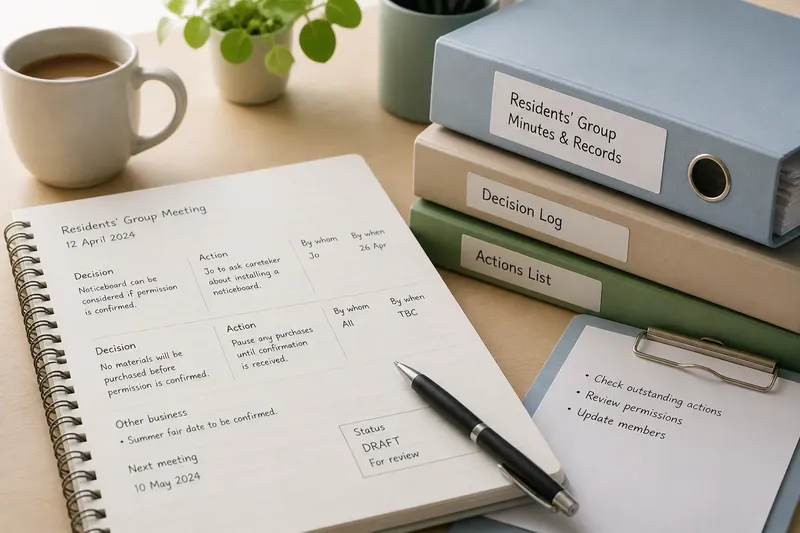
After the meeting, write down what you came to learn, what you heard, and what remains unclear. Separate a decision from a suggestion or an individual’s comment. If someone agrees to take an action, note the action and who is responsible only if that was stated plainly; do not infer a commitment from a general discussion.
Choose one follow-up that fits. You might check the published minutes, send the organiser your unanswered question, pass a short update to the person you represent, or add the next meeting to your calendar. If nothing needs doing, record that too. A concise note is enough to help you remember why you attended and whether another visit would be useful.
For a first-time participant, a community meeting is easier to approach when preparation has a clear limit: one reason, one relevant agenda item, one question, and one follow-up note. Keep that small plan for your next community meeting as well. It leaves room to change your view as you learn how the group works.